Wednesday, May 08, 2013

White Halo


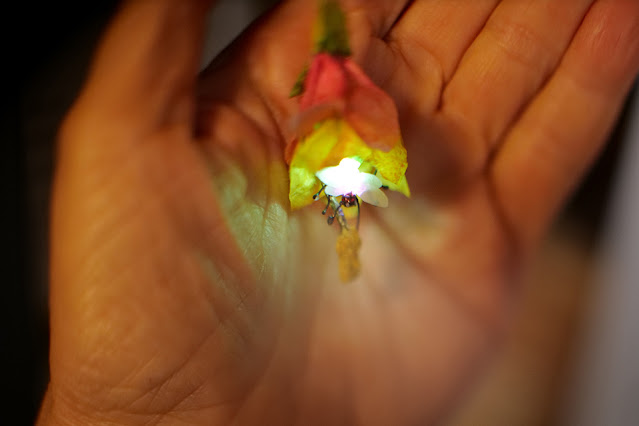
This test clip experiments for the first time with:
Tracking shot in 2 speeds (1/8" and 1/16" on second half) Pretty good although a bit clunky on my part.

Flying rig removal on moth at end (have to watch my arm shadow & use another kind of support) SO EASY!!!!!

Far landscape seamlessly blended to pond set thanks to Christine's brilliant lighting idea.

Christine animated the moth in the first half, all of the water ripples, and all of the watch works turning.

I used three different layers of textures on the frames:
1. A light smear of Vasoline on the camera UV lens.
2. Jeremy Birn's Barrel Distortion and Chromatic Aberrations Action in PS.
3. White vignetting, addition of grain, and downsized to 990 pixels wide Action in PS.

Friday, May 03, 2013

Holy Holga!!!

Very happy to report I discovered a possibly batch processable image effect that brings the vintage camera look to my Halfland footage that I thought I never could.

It's a Fake Barrel Distortion and Chromatic Aberration PS action written by Jeremy Birn. I combined it with other actions to vignette the edges a bit in the above test still but feel what Jeremy has created will provide the film with the magical storybook feel I so wanted. Thank you, Jeremy.

Thursday, May 02, 2013

The Color of Time

The equipment tests continue as we get closer to the look I'm after for the film.
This gets pretty darn close!

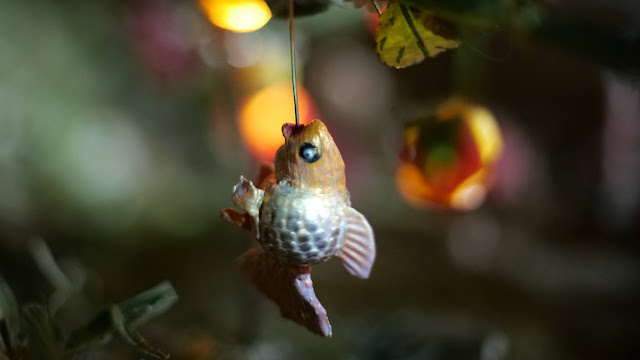
Above you see the finished Time Frog verdigris green patina puppet paint job (what else is the color of time?!) more clearly while the rest of the pond set has been blurred in camera with Vasoline© on the edges of the UV protection lens cover and then additionally enhanced in PS with a texture layer blended to multiply in green with burned out edges and erased over the frog.

Christine and I learned a tons in making today's test(s); how to gobo the window light to cut down the glare on the frog's left clock eye (above was my test with a paper watchface over his eye), that hot glue doesn't work on my set as tie down for his hands, that a piece of cardboard with a barcode on it allows us to focus on the plane of the frog's nose area instead of at the camera's field of center, that the pond water needs to stretch to make it more slack in order to ripple when touched between frames, the the whole set and room we are shooting in moves slightly regardless of how little we move--and/or the camera is somehow moving no matter how much we try to lock it down with every frame, that the shaking can be fixed in post production with Adobe After Effects, how to animate the Koi puppet with more minute movements and less often to get him swimming at a slower rate, that animating is far more fun than we thought it would be.

If you were here in the room with us, there is nothing you would rather do than make your own stop motion films.

Tuesday, April 30, 2013

Slurp


Trying to find out why on earth the earth moves during these tests. Mike kindly pointed out the unintentional shimmy.

This test is using the tripod head on smoothmover clamped to a piece of 1/2" plywood sitting on a crate on a sawhorse table next to the set sitting in a plastic tub.

(Previous test was the same only using a single tube articulated arm superclamped to a metal tray on the crate.)

Christine, who helped me finish prepping the set for this new test, and I figured the bounce of the arm was longer than the set's from the flexible floor moving. But now I'm thinking it's the set needing to be more secure, more firmly attached in place.

(It was also Christine's ingenious idea to create that green fuzzy painted faux fur cloth tacked at the back of the scene to fill in any gaps in any set up. She should patent that.)

Saturday, April 27, 2013

FIRST LIFE!! Puppets begin to move in Halfland


Frog Test Editlo - Computer from Shelley Noble on Vimeo. (fyi; right clicking on the play button and selecting "turn loop ON" will playback on auto repeat.)

This is a very big deal here, gang. For the very first time, The real production filming has begun in Halfland last weekend. Here, a very brief 60 frame test, shows the Finished Time Frog puppet moving for the first time, the first life in 1/2L. Did I say this was a big deal?

It's taken 20 years to get from when I thought of this film to the point now where all the sets and props are fully built, aka pre-production, is done and that the choice of method for filming has been made and equipment kindly loaned or aquired within our means. The project has now moved into PRODUCTION.

And now, thanks to many of your long standing encouragement and help, the actual shooting has begun. I sent up the official Bat Signal to 1/2L Hero, Dick Kaneshiro last Saturday and even though he had just finished a long week of very long days at his pro animation gig, he went to all the trouble to bring over equipment he hasn't needed to let me try it out to see whether it worked for what I wanted. It does!

By the time Christine! Kuper came to help out on Tuesday, we were able to set things up enough (thanks to her brains) to actual forge into frame-by-framing together to make this little test.

Since then, I've been searching out ways I could get a bit of atmosphere and texture into the straight capture to get a bit more of a storybook magical visual style with software I already own. Mike Brent once again and ever helpful, suggested I try a little manual batch processing to see if that would get me closer. Later versions of Adobe software will do this kind of adjustment layer effects more easily as will other Adobe video editing applications but I don't have those right now and want to see what can be done with what I have.

What you see above is the result of my hand placing a texture layer over and hand-blurring around the focal point of each frame. This isn't how I'll be making the entire film, just a test to see if what I had in mind could get anywhere close. I didn't pay too much attention to the precise placement of the texture layer over the base image and as a result it shimmies a bit like antique nickelodeon celluloid, which is kind of interesting and may have a place in the effects here and there.

Rule #44: Nothing is ever completely complete. Even when it seems like something is fully done, there will still likely be revisions and adjustments to be made once the Latex hits the Papier Maché, as it were.
Related Posts Plugin for WordPress, Blogger...